
Who’s in Your OR?

Locum tenens anesthesia historically served a specific purpose: fill a temporary gap. A physician went on medical leave, someone took an extended vacation or a provider departed before a replacement could start. A locum stepped in, covered the opening and moved on.
That model is changing. Across anesthesia, locums are increasingly being used not simply to bridge temporary gaps but to fill schedules week after week as groups struggle with vacancies, recruiting challenges and surgical demand. What was designed as temporary staffing can begin to look remarkably permanent, and that creates a different challenge.
Traditional interviewing has not disappeared. When groups recruit physicians for permanent positions, candidates still meet physicians, tour facilities, discuss expectations and determine whether the practice is right for them. The group evaluates the candidate, and the candidate evaluates the group. But that type of deliberate, in-depth interview process is utilized less often when more immediate staffing needs are being met through locums.
The Current Climate
Locum staffing operates under very different conditions. It’s Wednesday afternoon and Friday’s OR schedule has a hole. The hospital needs coverage; surgeons have cases booked, and the anesthesia group cannot produce another physician. A staffing agency has someone available. The license is active. References have been submitted. The National Practitioner Data Bank (NPDB) has been queried. Credentialing moves forward, privileges are granted and Friday morning a physician whom almost nobody in the group has met walks into the operating room.
The physician may be outstanding. But does anyone actually know? Credentialed is not the same as known.
This is not an argument against locum anesthesiologists or credentialing. Locums have become an essential part of the anesthesia workforce, and hospitals have substantial safeguards governing who receives privileges.
Hospitals must query the NPDB when practitioners apply for medical staff appointment or clinical privileges, including temporary privileges for locum tenens physicians. The database can identify malpractice payments, licensure actions, adverse clinical privilege actions, exclusions and other reportable events. Accreditation requirements add further protections. Joint Commission standards address peer recommendations involving clinical knowledge, technical skills, judgment, communication and professionalism. New privileges also trigger Focused Professional Practice Evaluation (FPPE), which can incorporate chart review, patient outcomes, complaints and peer input.
Those safeguards matter. But determining whether a physician is qualified to receive privileges is different from understanding whether that physician is clinically compatible with a particular practice environment.
A clean NPDB report cannot tell you how someone handled their last difficult airway. A CV may show 20 years of experience, but not what those 20 years looked like. Has the physician recently practiced in a tertiary hospital or primarily in freestanding ASCs? When was the last high-risk obstetric, pediatric or cardiac case? Has the anesthesiologist primarily practiced independently or medically directed CRNAs? How does the physician respond when a surgeon wants to proceed with a patient the anesthesiologist believes should be cancelled? Most importantly, how does this person behave when something goes wrong?
Those questions are difficult to capture in a credentialing file; yet, in anesthesia, they can matter enormously.
When Temporary Staffing Becomes Routine
The issue is not that anesthesia groups have forgotten how to interview physicians. The traditional interview remains an important part of permanent recruiting. But it is utilized less frequently than it once was because the staffing environment itself has changed.
Groups that once might have had the time and candidate pool to conduct extensive interviews are increasingly competing for a limited supply of anesthesiologists while simultaneously trying to fill immediate holes in the schedule. Positions can remain open longer, and locums may provide coverage while recruiting continues. The result is effectively two staffing processes operating at once: deliberate recruiting for permanent physicians and rapid deployment of locums to keep the OR schedule running.
The second process necessarily moves faster. Groups are managing vacancies, vacations, illness and recruiting difficulties within a surgical system that cannot simply stop because another anesthesiologist is unavailable. Locums have become the industry’s pressure-release valve.
But when locums are no longer covering an occasional leave or short-term vacancy and instead appear on the schedule month after month, the distinction matters. A process designed to place temporary physicians quickly may now be supporting a meaningful portion of the clinical workforce.
Anesthesia practice itself is also increasingly mobile. A physician might work at a hospital this week, an ASC next week and another health system later in the month. Each may have a different patient population, staffing model, equipment, clinical expectations and culture. Temporary staffing is starting to look considerably less temporary.
It is also important to note the distinction between a clinical locum and a billing locum: a clinical locum is the physician actually providing anesthesia care in the operating room, whereas a billing locum refers to a Medicare reimbursement arrangement that permits a temporary substitute physician’s services to be billed under the absent physician’s provider number for up to 60 consecutive days.
The National Association Medical Staff Services has already updated its Ideal Credentialing Standards to address evolving practice arrangements involving locum tenens practitioners. The workforce has changed. The question is whether clinical vetting should evolve with it.
Culture Fit Meets Clinical Compatibility
The answer may be surprisingly simple: before a locum arrives for that first assignment, make a phone call.
Talk to someone who recently practiced anesthesia beside that physician. A five-minute conversation may reveal something a hundred-page credentialing packet cannot. Then pay attention once the physician arrives. How do they communicate during emergencies? Do they ask for help when necessary or speak up when something is unsafe? Do they exercise sound judgment when production pressure collides with clinical concerns?
Groups have long considered some of this culture fit when hiring permanent physicians. As locum staffing becomes more common, clinical compatibility becomes equally important. Credentials tell us whether someone is qualified to practice anesthesia. Clinical compatibility tells us whether that physician’s recent experience, judgment, communication and practice style fit the environment in which they are being asked to work.
The formal credentialing framework already recognizes the importance of much of this information. The opportunity is not necessarily to create another administrative process. It is to make the information we already collect more meaningful.
Who’s in Your OR?
Locum anesthesia isn’t going away, nor should it. Locum physicians provide flexibility, fill genuine workforce gaps and allow facilities to keep operating when permanent staffing cannot meet demand. The concern arises when a staffing mechanism designed primarily to solve temporary problems becomes part of the permanent operating model.
If locums are going to represent a larger and more consistent part of the anesthesia workforce, clinical vetting should evolve accordingly. That could mean meaningful physician-to-physician references, attention to recent case mix, matching clinicians to facility acuity and structured feedback after initial assignments.
None of this suggests abandoning the traditional interview. For permanent recruitment, it remains valuable to both the group and the physician. But when a growing portion of the staffing equation is solved outside that process, groups need another way to obtain some of the clinical intelligence that a good interview and thoughtful recruiting process traditionally provided.
We have become extraordinarily good at verifying licenses, education, privileges, claims history and credentials before a physician enters the operating room. That’s progress. Yet it creates a strange possibility: we may know more about an anesthesiologist’s credentials than ever before while knowing less about the anesthesiologist.
Anesthesia
Explore specialty revenue cycle expertise
See how Coronis Health supports organizations with specialty-focused teams, workflows, and technology.
recommended
More Resources
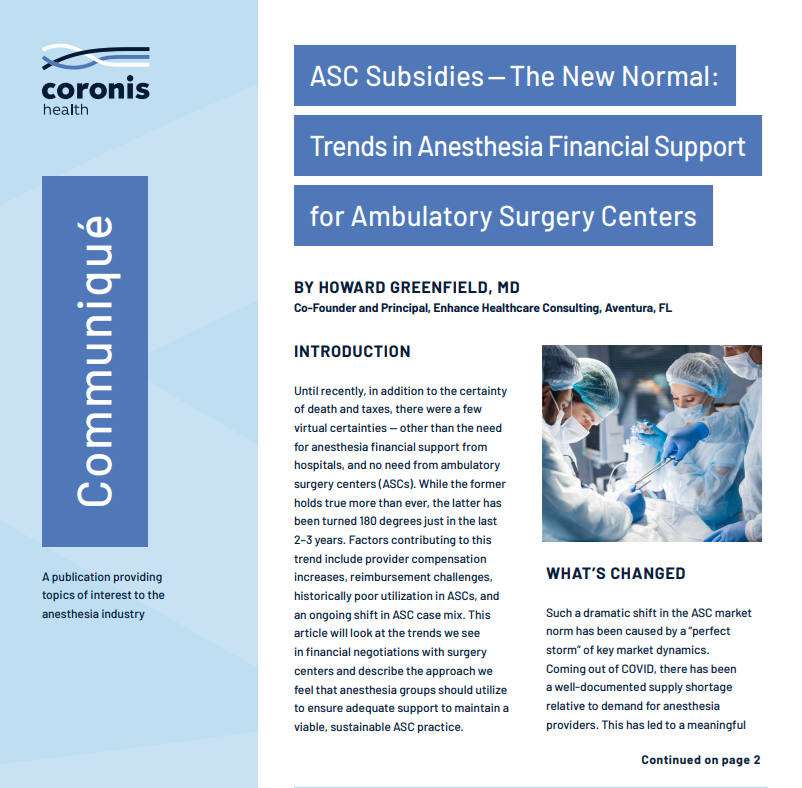
Fall 2026 Communiqué
Download the Fall 2026 Communiqué issue.

Sicker Patient, Same Pay … or Acuity Without Compensation
The Quiet Disappearance of Anesthesia Physical Status Units For decades, anesthesia has recognized patient acuity through physical status modifiers: P3 – Severe systemic disease…

Drive-By Zoomers: Younger Healthcare Workers Exploring Other Options
Discover why younger healthcare workers are exploring other career options and what healthcare organizations can do to improve employee retention.
Let's discuss your transformation
Wherever you want revenue cycle operations to go, we can help!
-
step 1
Connect
Tell us about your organization, specialty and revenue transformation goals.
-
step 2
Evaluate
We'll evaluate your current state and identify strategic opportunities for improvement.
-
step 3
Transform
Together we'll implement solutions that improve performance from day one.
