Security, Privacy and Compliance, Protected

We are committed to safeguarding the integrity of every patient record, payment transaction, and claims workflow entrusted to our platform. Our security program is independently audited, continuously monitored, and designed to meet the regulatory demands of healthcare revenue cycle management.

security certifications

We take security and compliance seriously

Coronis Health aligns with leading security frameworks and undergoes regular independent audits to validate our data security controls.

Security certifications

how we protect your data

Our comprehensive approach to RCM security

Our security framework brings together the operational, technical, and compliance disciplines required to protect healthcare data and support resilient revenue cycle operations.

Security implementation

Implementation is essential for security safeguards

End-to-end encryption

All protected health information (PHI) and payment data transmitted across our Revenue Cycle Management platform are encrypted in transit with TLS 1.2+ and at rest with AES-256, safeguarding sensitive billing and claims data from unauthorized access.

Role-based access control (RBAC)

Access to patient financial records, claim submissions, and remittance data is governed by least-privilege principles, ensuring that staff and third-party vendors can access only the information necessary to perform their specific RCM functions.

Continuous vulnerability management

Our infrastructure undergoes regular penetration testing, automated vulnerability scanning, and timely patching to proactively identify and remediate risks in our claims processing and billing environments.

Multi-factor authentication

All users accessing RCM systems — including billing staff, coders, and healthcare provider partners — must authenticate with MFA, reducing the risk of unauthorized access from compromised credentials.

AI-enabled threat detection

When AI and machine learning capabilities are used in our security operations, they are subject to the same access controls, data-handling standards, and oversight processes as all other platform components, ensuring they enhance — rather than introduce risk to — our security posture.

employee training and awareness

Our employees are key to ensuring the security of our clients

Mandatory HIPAA and security training

All employees and contractors with access to PHI or RCM systems must complete HIPAA Privacy and Security training upon onboarding and annually thereafter, reinforcing their obligations under federal healthcare data regulations.

Role-specific RCM security education

Targeted training modules are delivered to billing specialists, coders, denial management teams, and IT staff, addressing the data-handling risks inherent to each function within the revenue cycle workflow.

Responsible AI-use awareness

Staff are trained on the appropriate and responsible use of AI-powered tools on our platform, including an understanding of AI limitations, the importance of human oversight of automated outputs, and acceptable use policies governing AI capabilities in healthcare operations.

Phishing simulations and social engineering drills

Regular simulated phishing campaigns test employee vigilance and are paired with immediate educational feedback, helping staff recognize and report threats targeting healthcare billing and payment systems — including AI-enhanced social engineering tactics.

Incident reporting culture

Employees are empowered by a clear, no-fault reporting process to escalate suspected security incidents or data-handling concerns, ensuring swift identification of potential breaches involving RCM data.

Data governance

Built-in security and compliance at the core of our operations

Dedicated information security leadership

A Chief Information Security Officer (CISO) and Privacy Officer provide executive-level oversight of the security program, ensuring risk management decisions are aligned with the operational and regulatory demands of healthcare revenue cycle services.

AI governance policy

We maintain a formal AI governance policy that establishes principles for the responsible use of AI across our organization — covering transparency, accountability, fairness, and data privacy. AI tools used within our RCM platform are evaluated and approved against these standards before deployment.

Third-party vendor risk management

All Business Associates and technology vendors — including those providing AI-powered capabilities — undergo security assessments and execute Business Associate Agreements (BAAs) before any data exchange, in accordance with HIPAA requirements.

Enterprise risk assessments

Periodic risk assessments — aligned with the NIST Cybersecurity Framework and the HIPAA Security Rule — identify, evaluate, and prioritize risks across RCM workflows, including those associated with the use of automated and AI-assisted tools in claims and payment processing.

Security steering committee

A cross-functional governance committee — comprising IT, compliance, legal, and operations leadership — meets regularly to review the risk posture, approve policy changes, and oversee the adoption of emerging technologies, including the responsible integration of AI capabilities into RCM operations.

Business continuity

Ensuring we keep operating, so you keep operating

RCM-specific disaster recovery planning

Documented and tested disaster recovery plans ensure that critical revenue cycle functions — including claims processing, payment posting, and prior authorization — can be restored rapidly following a system disruption or cyberattack.

Defined Recovery Time and Point Objectives

We maintain clear RTO and RPO targets for all mission-critical RCM systems, ensuring healthcare organizations can plan around maximum acceptable data loss and service recovery timelines.

Redundant infrastructure and high availability

Our RCM platform is hosted across geographically redundant data centers with automatic failover capabilities, minimizing downtime and ensuring uninterrupted access to billing and claims data for healthcare provider clients.

Regular BCP testing and tabletop exercises

Business continuity and incident response plans are tested through scheduled tabletop exercises and simulations — including ransomware scenarios — validating our ability to maintain RCM operations under adverse conditions.

Data backup and integrity controls

PHI and financial data are backed up automatically on a scheduled basis, stored in encrypted and access-controlled environments, and validated regularly to ensure recoverability and data integrity across the revenue cycle. Systems that leverage AI-assisted processing include manual fallback procedures to maintain continuity if automated capabilities are unavailable.

compliance and privacy

Independently validated - because compliance is everything

HIPAA Privacy and Security Rule compliance

Our RCM operations are designed and audited to comply with all applicable HIPAA Privacy and Security Rule requirements, including appropriate use and disclosure of PHI, minimum necessary standards, and safeguards for electronic health information.

Responsible AI and regulatory alignment

The use of AI on our platform is governed by applicable regulatory guidance and emerging industry standards for AI in healthcare. We are committed to ensuring that any AI-assisted capabilities used in RCM workflows are transparent and explainable and do not compromise patient privacy or data integrity.

PCI DSS compliance via certified clearinghouses and SAQ

Patient payment transactions are routed through PCI DSS-certified clearinghouses and payment partners, ensuring that cardholder data is handled by rigorously validated third-party infrastructure. We also maintain annual compliance as a service provider by completing a PCI DSS Self-Assessment Questionnaire, which validates that our processes, controls, and vendor relationships meet the full scope of PCI DSS requirements applicable to our role in the payment chain.

Privacy by design and patient rights

Privacy principles are embedded throughout our RCM platform's development lifecycle. We support healthcare providers in honoring patient rights under HIPAA — including the rights to access, amend, and restrict the use of their health and financial information

Independent audits and certifications

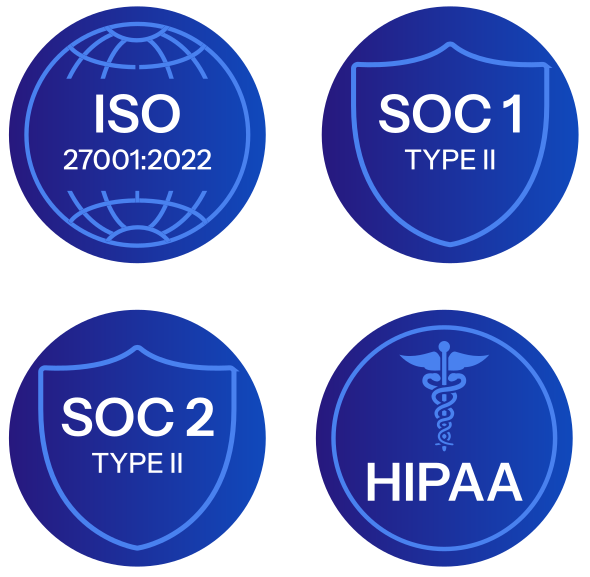
We undergo regular independent security assessments, including SOC 1 Type II audits, SOC 2 Type II audits, ISO 27001:2022, and HIPAA compliance reviews, to provide our healthcare clients with third-party validation of our controls and a transparent record of our compliance posture.

Get the answers you need

Connect directly with the right Coronis Health team.

Talk to our security team

Request an audit report. SOC Reports, ISO 27001:2022, and HIPAA compliance documentation are available to qualified prospects and clients under an NDA.

Contact Security

Ready for RCM transformation?

Ready to explore how Coronis Health can support your revenue goals? Start a conversation with our team.

Talk To A Specialist