
RCM Reporting and Analytics: From Restrospective Reporting to Actionable Intelligence Webinar
Key Takeaways
Carrie Laureano-Meggett, Project Manager, Physician Billing at Coronis Health, presented this session to a multispecialty-practice audience for Becker’s Healthcare, hosted by Rosie Talaga, walking through how RCM analytics is shifting from retrospective reporting toward real-time, predictive, and behavior-driving insight. The talk covers the current state of revenue cycle analytics, where AI and prediction fit, the data foundation required to support them, and what advancing analytics maturity looks like in practice.
- Revenue cycle is now a leadership capability, not a back-office function. Rising payer complexity and shrinking margins mean revenue cycle performance directly affects financial results, scalability, and patient access — no longer just a transactional or operational concern.
- More data isn’t the problem — inaction is. Most organizations already have strong dashboards and reports, but retrospective reporting means the opportunity to intervene has often already passed by the time issues are reviewed.
- Speed has changed the game, not just complexity. Data is now available earlier in the workflow, letting teams spot eligibility, authorization, and denial risk before claims are even submitted — but only if that visibility translates into fast action.
- AI amplifies maturity, it doesn’t create it. Predictive analytics only adds value once foundational data governance and workflows are in place; without that foundation, AI simply accelerates noise.
- AI informs action, but leaders and teams still own outcomes. High-performing organizations use AI as a decision-support tool — flagging risk, recommending next-best actions, and highlighting trends — while people retain judgment and accountability.
- Executive and operational analytics need to stay separate, but aligned. Executives need visibility into trends, risk exposure, and financial impact, while frontline teams need workflow-level guidance on exactly what to do next.
- Trust in the data is the foundation everything else depends on. Without accuracy, consistent definitions, and strong governance, even the most advanced analytics will struggle to scale.
- Analytics only creates value when it changes behavior. Insights have to be embedded directly into daily workflows — guiding what to work, when, and why — or they remain reports nobody acts on.
- Common pitfalls slow analytics maturity: chasing tools, tracking too many metrics, and treating analytics as an IT-only function. The guiding principle for high performers is that if a metric doesn’t drive a decision or an action, it doesn’t belong.
- Analytics maturity is measured by consistency, not sophistication. It’s defined by how reliably insights lead to better decisions and measurable outcomes — not by how advanced the tools are.
View Transcript
Speaker Introduction
Rosie Talaga: I’d like to introduce today’s speaker, Carrie Laureano-Meggett, Project Manager, Physician Billing at Coronis Health.
Thank you, Carrie, for being here today. So a little intro for Carrie: she is a certified project manager and revenue cycle leader with extensive experience guiding physician billing teams through complex operational and financial transformation. She brings over 20 years of experience as a certified Lean Six Sigma Master Black Belt, applying process discipline, change management, and data-driven strategy to improve revenue cycle performance. With that, Carrie, we’re pleased to have you, and I will now turn the floor over to you to get us started.
Welcome and Session Overview
Carrie Laureano-Meggett: Thank you, Rosie. Hello, everyone, and welcome. We appreciate you taking the time to join us today. We’re looking forward to sharing practical insights on how analytics is evolving within the revenue cycle.
We’ll start by grounding ourselves in today’s RCM analytics landscape — what’s working, what’s breaking, and why change is accelerating. From there, we’ll look at emerging trends, the foundational elements required to support meaningful analytics, and how insights actually turn into action. We’ll close by outlining what advancing analytics maturity looks like in practice, key takeaways you can apply immediately, and leave time for Q&A.
The RCM Analytics Landscape: Data Without Action
Carrie Laureano-Meggett: Let’s start with a simple question: how many of you feel like your teams are working harder than ever in revenue cycle? But the results don’t always reflect the effort.
Across the industry, revenue cycle teams are navigating more payer rules, tighter margins, and rising expectations — often without more time or resources. And while most organizations have more data than they’ve ever had before, many still struggle to turn that data into timely action. That’s the tension we see again and again: plenty of data, but not always the clarity or speed needed to impact results.
Increasing payer complexity and margin pressure remain top of mind for us today. The revenue cycle environment is more complex than it has ever been. Revenue cycle teams are navigating an expanding set of payer rules, more frequent edits, and shrinking margins — often without added staff or additional time across specialties. Organizations are managing growing variability in payer requirements and reimbursement logic, all while operating under tighter financial pressure. The combined effect is a revenue cycle that demands greater accuracy, speed, and coordination just to maintain performance.
At the same time, expectations around both financial performance and patient access continue to rise. This creates a situation where revenue cycle is no longer just a transactional or back-office function — it plays a direct role in sustaining organizational performance and enabling growth to remain financially viable. What we consistently see are organizations that begin to think differently about how they operate within revenue cycle. If any of this feels familiar, you’re not alone, and it’s exactly what we’ll focus on today.
From Complexity to Timing: Why This Moment Is Different
Carrie Laureano-Meggett: What makes this moment different isn’t just complexity — it’s timing. Data is available earlier in the workflow than ever before. We can see risk forming — whether it’s eligibility, authorization, or denial exposure — before claims are submitted or revenue is lost. The challenge isn’t visibility anymore; the challenge is what to do with that visibility, and how quickly we act on it.
That’s why today, revenue cycle analytics is no longer an IT topic or a reporting exercise. It’s a leadership capability — one that directly influences financial performance, scalability, and patient access.
Most organizations today already have a strong reporting foundation. There’s no shortage of dashboards or reports available: charges, payments, denial rates, days in AR, and productivity metrics are widely tracked. However, the challenge isn’t the availability of data — the challenge is how and when that data is being used. In many cases, reporting remains retrospective. By the time insights are reviewed, the issue has already occurred, and the opportunity to intervene has already passed. Teams are left analyzing what happened rather than influencing what will happen next.
What has changed is not just the complexity, but the speed at which data is available. Organizations now have the ability to see issues earlier, identify trends faster, and understand performance in near real time. This creates a significant opportunity — but only if that data can be translated into action quickly. As a result, analytics maturity is no longer a technical initiative. It has become a leadership priority.
From Retrospective Reporting to Real-Time Action
Carrie Laureano-Meggett: So with that context, let’s talk about how revenue cycle analytics is evolving — specifically, what’s changing and how organizations are using data to drive results.
Today, when we think about the shift from reporting to real-time, actionable intelligence, we’re thinking specifically about the shift from retrospective reporting to real-time action. What does that mean? What’s specifically changing is that leaders want to know what’s happening now, not just what happened last month.
Traditionally, analytics explains what already happened through monthly dashboards, lagging indicators, and post-mortem reviews. Today, organizations are shifting toward near-real-time visibility that surfaces issues while there is still time to intervene. You may wonder why this matters: it allows teams to address risk within the workflow before claims are denied, before AR ages, and before rework is required — rather than reacting after revenue has already been impacted.
Where AI Fits: Predictive Analytics as Decision Support
Carrie Laureano-Meggett: So once visibility improves, the next evolution is prediction.
This is where AI-supported predictive analytics enters the conversation — not as a replacement for people or processes, but as a way to scale insight across an increasingly complex revenue cycle. AI becomes relevant only when foundational data governance and workflows are in place. Without that foundation, predictive tools simply accelerate noise. Keep in mind: AI amplifies maturity, it doesn’t create it.
Predictive models use historical patterns, payer behavior, authorization history, documentation gaps, and prior outcomes to identify claims with a higher likelihood of denial or underpayment before they’re submitted. Rather than treating all claims equally, the model highlights where risk is most likely to occur. Teams can then proactively correct issues upstream, focusing effort where it will prevent the most revenue loss. This reduces avoidable denials, decreases rework, and protects revenue that would otherwise be written off or delayed.
Once risk is identified early, the next challenge becomes focus. Reporting is no longer the end state — it’s the starting point for action.
Automation in this context doesn’t replace staff; it prioritizes their time. Instead of working AR strictly by aging or volume, analytics helps rank work based on dollar impact, payer behavior, and likelihood of recovery. Skilled staff spend less time on low-yield work and more time on accounts that actually move financial performance. Productivity improves not by working faster, but by working smarter.
A critical clarification at higher levels of analytics maturity is this: AI does not run the revenue cycle. High-performing organizations use AI as a decision-support mechanism — flagging risk, recommending next-best actions, and highlighting trends — while humans retain judgment, accountability, and control. The most effective models combine machine pattern recognition with operational expertise and clinical context.
Here’s an important distinction: AI informs action. Leaders and teams still own outcomes. Of course, these insights only matter if they reach the right people.
Executive Dashboards vs. Operational Analytics
Carrie Laureano-Meggett: Let’s talk about executive dashboards versus operational analytics. High-performing organizations differentiate between executive and operational views.
Executives see trends, risk exposure, and financial impact, while frontline teams receive workflow-level guidance on exactly what actions to take. This alignment ensures that insights match decision-making needs, reduces noise, accelerates response, and improves accountability across the organization.
Building an Integrated Data Foundation
Carrie Laureano-Meggett: All of this progress relies on one foundational element: trust in the data. So next, we’ll walk through what it takes to build an integrated data foundation that supports speed, confidence, and action — not just reporting. Many issues that appear as financial problems originally surface upstream, in documentation, authorization, or medical necessity.
When data sources remain siloed, organizations can see what happens, but not why. By aligning clinical, financial, and payer data, organizations gain a more complete view of performance and can connect outcomes to root causes.
Organizations must establish a strong data foundation built on accuracy, consistency, and trust. Different definitions of key metrics can create conflicting views of performance and slow decision-making. The outcome we’re aiming for is not perfect data — it’s reliable data that teams trust enough to act on.
When data is consistent and trusted, leaders can focus on action instead of validation. Decision cycles shorten, accountability improves, and teams align around a shared understanding of performance. Without this foundation, even the best analytics will struggle to scale.
From Insight to Behavior: Embedding Analytics into Workflows
Carrie Laureano-Meggett: Once that foundation is in place, the real question becomes how insights actually change day-to-day behavior.
Analytics only creates value when it changes behavior. High-performing organizations embed insights directly into workflows, guiding teams on what to work, when to work it, and why it matters.
This is where performance changes — when teams know exactly what to work on, why it matters, and how success will be measured. This is where organizations translate insights into impact: teams understand expectations, and leaders gain visibility into where intervention is needed — shifting conversations to objective, data-driven discussions.
Organizations begin to focus on leading indicators that reflect prevention, efficiency, and impact, not just traditional lagging metrics. This enables a more proactive approach to performance management.
So the question becomes: where are you today, and what should come next?
Where Are You Today? Stages of Analytics Maturity
Carrie Laureano-Meggett: Advancing analytics maturity is not a one-size-fits-all journey. The right next step depends on your organization’s current stage. Most organizations listening today will find themselves in one of three stages.
If you’re early in the journey, early-stage organizations should focus on building visibility and trust in their data. This includes establishing consistent metric definitions, improving data quality, and reducing manual reconciliation efforts. For many organizations, this is the turning point.
Mid-stage organizations are typically ready to move beyond visibility and begin leveraging insights. At this stage, analytics should be used to prioritize work, guide staff focus, and reduce avoidable rework across the revenue cycle.
At the most advanced stage, organizations shift toward prediction and scalability. This means using data to anticipate risk, automate prioritization of high-impact work, and support faster, more confident executive decision-making.
As organizations mature, analytics evolves from explaining past performance to actively shaping future outcomes, rather than focusing solely on what has already happened. Mature analytics helps teams anticipate what’s most likely to happen next. Predictive capabilities allow organizations to identify risk earlier — whether that’s the likelihood of denial, exposure to underpayments, or emerging workflow inefficiencies — so action can be taken before issues materialize and impact performance.
At the same time, AI is increasingly used to reduce repetitive manual analysis. Tasks such as identifying denial drivers, detecting payment variances, or tracking payer behavior across thousands of transactions can be standardized and automated. This doesn’t eliminate oversight — it strengthens it. Teams spend less time searching for problems and more time solving them.
A key indicator of analytics maturity is this shift in role: analysts move from building reports to acting as problem solvers and strategic partners. In parallel, leading organizations begin to operationalize analytics as scalable, repeatable assets instead of one-off analysis. Predictive models become embedded into daily operations, consistently guiding decisions across teams and functions.
It’s important to note that predictive analytics is only effective when built on a strong foundation. Without trusted data and adoption of early-stage practices, advanced analytics can introduce noise rather than clarity. True maturity comes when prediction is grounded in reliability, alignment, and action.
Common Pitfalls That Slow Analytics Progress
Carrie Laureano-Meggett: As organizations invest in analytics, several common challenges can slow progress. One of the most frequent pitfalls is focusing on tools instead of outcomes. Adding more dashboards or platforms does not inherently improve performance unless they are tied to clear business decisions.
Another challenge is metric overload. When too many metrics are tracked without clear prioritization, teams can’t always focus on what truly drives performance.
Organizations also risk limiting impact when analytics is treated solely as an IT function. Analytics must be owned and led by the business to ensure insights translate into operational action.
High-performing organizations address these challenges by maintaining a clear principle: if a metric does not drive a decision or an action, it does not belong.
Scaling Analytics as Organizations Grow
Carrie Laureano-Meggett: As organizations grow — adding providers, payers, and increasingly complex contracts — analytics must evolve alongside that complexity. The foundation for this growth starts with standardization. Shared definitions, consistent logic, and strong data governance ensure insights remain reliable and trusted as volume increases.
Just as important is aligning insights to the right level of decision-making. Executive leaders need clear visibility into macro trends and emerging risk, while operational and frontline teams require actionable guidance embedded directly into their daily workflows.
As RCM organizations scale by volume, payer mix, and geographic footprint, AI and predictive analytics help maintain consistency across teams and locations. These capabilities allow leadership to extend oversight and decision support without relying on institutional knowledge or individual heroics. This often marks the defining milestone in analytics maturity — when performance no longer depends on who is watching, but is built into how the system operates.
Over time, analytics becomes part of the organization’s operating rhythm. Leadership conversations shift away from reconciling numbers and toward deciding where and how to intervene. Rather than slowing decisions, a strong analytics foundation accelerates them by reducing ambiguity, enabling focus, and eliminating unnecessary work.
What Analytics Maturity Really Means
Carrie Laureano-Meggett: Analytics maturity is not defined by how advanced the tools are. It is defined by how consistently insights drive better decisions and measurable outcomes.
Organizations that achieve maturity create an environment where data is trusted, insights are actionable, and decisions are made proactively — enabling sustained performance even as complexity continues to grow.
Closing
Carrie Laureano-Meggett: With that said, let’s recap some of the key takeaways.
Revenue cycle is no longer just operational — it directly impacts financial performance, scalability, and patient access.
More data isn’t the problem; inaction is. Most organizations have visibility but fail to act on it fast enough to change the outcome.
The shift from reactive to proactive means moving from retrospective reporting to real-time insights and predictive actions.
Aligned data unlocks real insights. Aligning clinical, financial, and payer data moves teams from learning what happens to why it happens.
Analytics maturity is about behavior, not tools. Success comes from embedding insights into workflows, not adding dashboards.
Physician & Multi-Specialty
Explore specialty revenue cycle expertise
See how Coronis Health supports organizations with specialty-focused teams, workflows, and technology.
recommended
More Resources
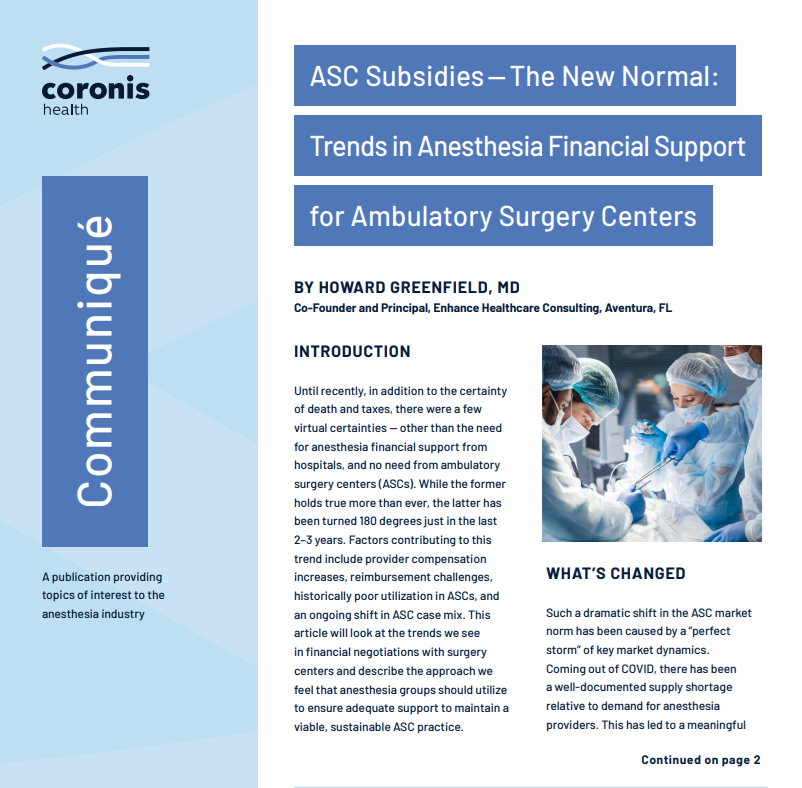
Fall 2026 Communiqué
Download the Fall 2026 Communiqué issue.

Why Revenue Gets Stuck: Finding the Operational Breakdowns That Delay Payment
Revenue cycle problems do not always come from one major failure. More often, payment is delayed by smaller operational breakdowns that happen across billing…

AI and the Revenue Cycle: What’s Actually Working Right Now
Doug Marcy, CTO of Coronis Health, shares real lessons from a year of AI deployments in revenue cycle management — including custom knowledge graphs,…
Let's discuss your transformation
Wherever you want revenue cycle operations to go, we can help!
-
step 1
Connect
Tell us about your organization, specialty and revenue transformation goals.
-
step 2
Evaluate
We'll evaluate your current state and identify strategic opportunities for improvement.
-
step 3
Transform
Together we'll implement solutions that improve performance from day one.
