
Sicker Patient, Same Pay … or Acuity Without Compensation

The Quiet Disappearance of Anesthesia Physical Status Units
For decades, anesthesia has recognized patient acuity through physical status modifiers:
P3 – Severe systemic disease → traditionally +1 unit
P4 – Severe systemic disease that is a constant threat to life → traditionally +2 units
P5 – Moribund patient not expected to survive without the operation → traditionally +3 units
Those units reflect a basic reality: the patient matters as much as the procedure.
Another Payer Stops Paying
Effective June 15, 2026, for professional claims (July 15 for facility claims), Sentara Health Plans stopped providing additional reimbursement for P3, P4 and P5 modifiers across its Commercial, Medicaid and Medicare products.
Sentara joins Medicare (which does not provide additional payment for these modifiers), Aetna (which eliminated reimbursement under affected Medicare Advantage and commercial policies), UnitedHealthcare (which removed them from calculations for affected Commercial and Individual Exchange plans in 2025) and several Blue Cross Blue Shield plans operated by Health Care Service Corporation, including Texas, Illinois, Oklahoma and New Mexico.
Thankfully, this nonpayment policy is not yet universal. Some commercial plans continue to recognize additional units based on the patient’s physical status classification.
The result is a familiar billing problem: same patient, same anesthetic, same physical status modifier, different payer, different payment.
A Real-World Example
One P4 can be worth $150 … or $0. Under a contract recognizing two additional units, a P4 patient would generate $150 at a hypothetical $75 conversion factor. Now, let’s expand this:
- 2 units × $75 = $150
- Across 1,000 P4 cases, that equals $150,000
The patient did not become healthier. The anesthesia provider did not assume less risk. The payer simply stopped recognizing that risk in its reimbursement formula.
Consider Modifier Nonpayment When Negotiating Rates
When negotiating payer contracted rates, groups should account for whether the payer recognizes and reimburses physical status modifiers.
A rate that appears competitive on a base-unit or conversion-factor comparison may be materially lower once unpaid P3, P4 and P5 units are considered. Contract analyses should therefore evaluate the payer’s complete reimbursement methodology, including:
- Whether physical status modifiers are recognized
- Whether additional units are paid, bundled or excluded
- Which products and lines of business are affected
- The practice’s actual P3, P4 and P5 case mix
- The resulting effective payment per case
If a payer will not reimburse for the additional acuity reflected by these modifiers, that limitation should be addressed directly in rate negotiations. Higher base and time rates or other contractual adjustments may be necessary to offset the lost reimbursement.
Keep Reporting P3, P4 and P5
Groups should continue documenting and reporting accurate physical status when appropriate—even when a payer provides no additional payment. Why? Because P3, P4 and P5 data creates a measurable record of patient acuity over time. For example:
- Are patients becoming more medically complex?
- Is the hospital or ASC population getting sicker?
- Has a service line shifted from predominantly P2 patients to P3 and P4?
- Is the practice taking on greater clinical risk without corresponding reimbursement?
That information can support contract negotiations, hospital subsidy discussions, staffing decisions and efforts to demonstrate how the practice’s clinical burden has changed. Abandoning the modifiers could erase the evidence needed to prove that change.
The definitions of P3, P4 and P5 have not changed. The patients have not become healthier, and the anesthesia provider’s responsibility has not diminished.
Continue documenting acuity. Continue reporting it accurately. Keep the data. Today’s unpaid modifier may become tomorrow’s evidence that an anesthesia practice is caring for a substantially sicker population than it did five or ten years ago.
Risk hasn’t disappeared. Increasingly, the payment has.
Anesthesia
Explore specialty revenue cycle expertise
See how Coronis Health supports organizations with specialty-focused teams, workflows, and technology.
recommended
More Resources
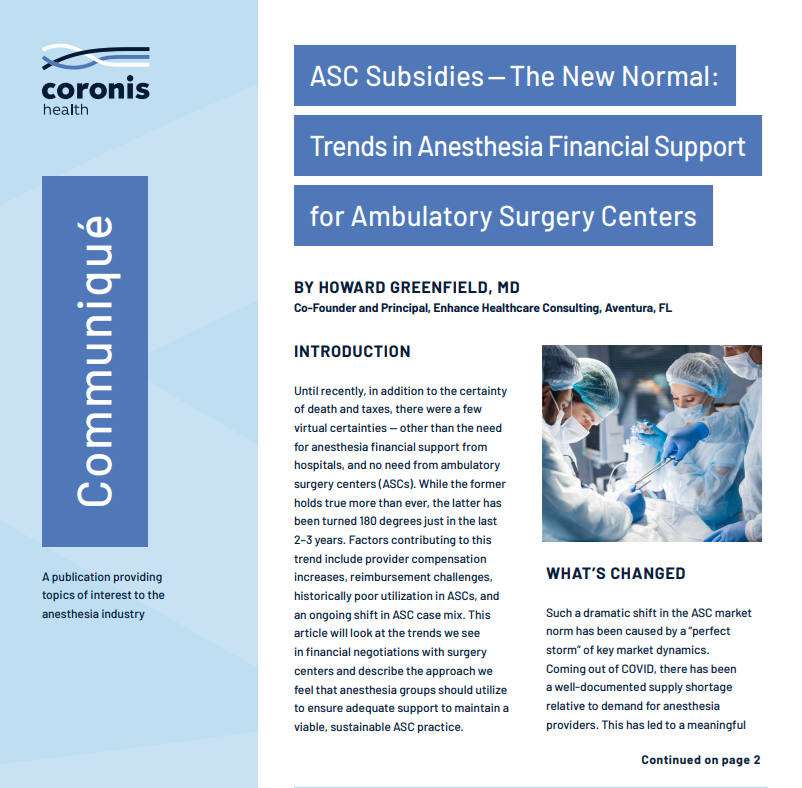
Fall 2026 Communiqué
Download the Fall 2026 Communiqué issue.

Drive-By Zoomers: Younger Healthcare Workers Exploring Other Options
Discover why younger healthcare workers are exploring other career options and what healthcare organizations can do to improve employee retention.

Vendors, Vultures and Violations: A Case Study
Learn how healthcare vendor arrangements can create False Claims Act and Anti-Kickback Statute risks, and why medical practices need legal guidance.
Let's discuss your transformation
Wherever you want revenue cycle operations to go, we can help!
-
step 1
Connect
Tell us about your organization, specialty and revenue transformation goals.
-
step 2
Evaluate
We'll evaluate your current state and identify strategic opportunities for improvement.
-
step 3
Transform
Together we'll implement solutions that improve performance from day one.
