
Medicare to Deny Anesthesia for Facet Injections

The trend continues. At least as it concerns Medicare, times are getting harder for anesthesia providers in the context of pain injection procedures. As you will recall, Medicare published a policy three years ago, advising that anesthesia for facet joint interventions would rarely be reimbursed. The policy was worded thusly:
General anesthesia is considered not reasonable and necessary for facet joint interventions. Neither conscious sedation nor monitored anesthesia care (MAC) is routinely necessary for intraarticular facet joint injections or medial branch blocks and are not routinely reimbursable.
So, under the current policy, a general anesthetic is always medically unnecessary in facet cases, while MAC may—in very limited circumstances—be reimbursed. Now, with a new series of Medicare announcements, the door to reimbursement that had been slightly ajar has now been slammed shut. Five Medicare contractors—Noridian, CGS, NGS, WPS and Palmetto—have developed a new policy that expressly bars reimbursement for anesthesia in connection with facet injections—regardless of anesthesia technique. The wording of the new policy is as follows: “Use of Moderate or Deep Sedation, General Anesthesia, and Monitored Anesthesia Care (MAC) is not considered medically reasonable and necessary during facet injections.”
The only redeeming aspect of the new policy is that it holds out the possibility of reimbursement for anesthesia in connection with facet radiofrequency ablation (RFA) procedures. On that score, the policy states: “Routine use of Moderate Sedation or Monitored Anesthesia Care (MAC) or use of General Anesthesia or Deep Sedation for RFA is not considered reasonable and necessary.” Note the operative words: “Routine use.” So, under certain rare and specified circumstances, MAC may be reimbursed by Medicare for facet RFA. What are those circumstances? Another document published by Noridian provides the contractor’s response to various submitted comments concerning the policy. The payer’s response relative to payment in RFA cases is as follows:
In cases where there is longstanding well-documented history of inability to cooperate, medical conditions that would prohibit performance of the procedure, or inability to remain motionless, anesthetic for facet RFA will be considered. The provider should document why the anesthesia is necessary for the individual patients.
Though two Medicare carriers (First Coast and Novitas) have yet to publish a similar update to their current facet policy, we expect their new policies to be released soon and to be consistent with the language found in the updated policies of the five other carriers. The new policy language will become effective on July 7 for Noridian, CGS and Palmetto. The effective date for the WPS policy is July 14, while the effective date for the NGS policy is August 1.
Anesthesia
Explore specialty revenue cycle expertise
See how Coronis Health supports organizations with specialty-focused teams, workflows, and technology.
recommended
More Resources
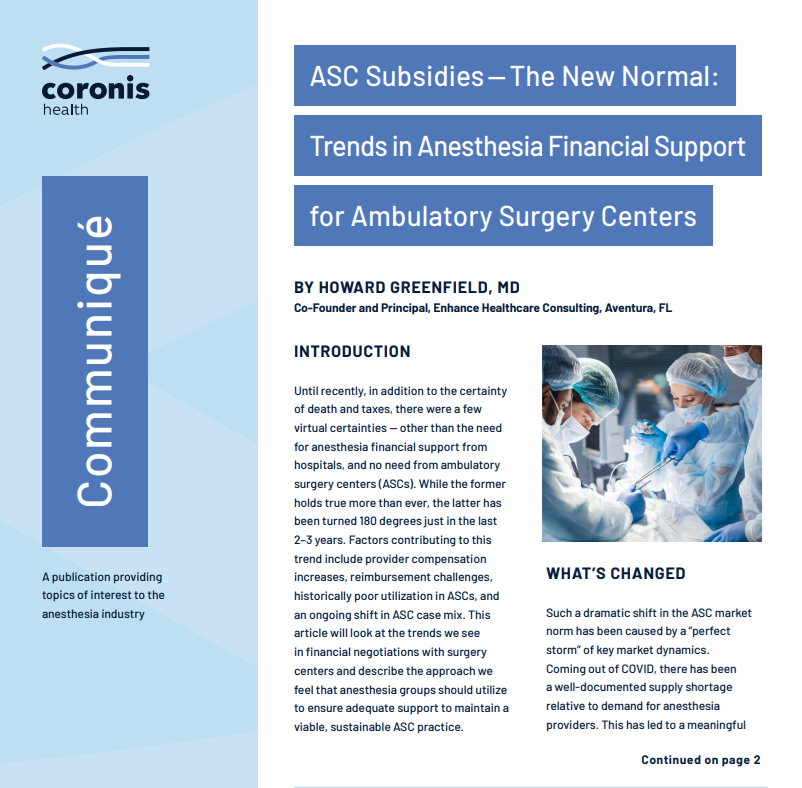
Fall 2026 Communiqué
Download the Fall 2026 Communiqué issue.

Why Revenue Gets Stuck: Finding the Operational Breakdowns That Delay Payment
Revenue cycle problems do not always come from one major failure. More often, payment is delayed by smaller operational breakdowns that happen across billing…

AI and the Revenue Cycle: What’s Actually Working Right Now
Doug Marcy, CTO of Coronis Health, shares real lessons from a year of AI deployments in revenue cycle management — including custom knowledge graphs,…
Let's discuss your transformation
Wherever you want revenue cycle operations to go, we can help!
-
step 1
Connect
Tell us about your organization, specialty and revenue transformation goals.
-
step 2
Evaluate
We'll evaluate your current state and identify strategic opportunities for improvement.
-
step 3
Transform
Together we'll implement solutions that improve performance from day one.
