
Considering the Alternative: Behind the Push for Alternative Payment Models

“There are always alternatives,” Mr. Spock confidently asserts to a fellow crew member. For non-aficionados of the old Star Trek series, the takeaway is simply this: there are often options we may not have considered. For most clinicians involved in Medicare’s Quality Payment Program (QPP), the Merit-based Incentive Payment Program (MIPS) has been their preferred avenue of participation. Increasingly, however, we’re seeing more eligible providers explore alternative payment models (APMs) to meet QPP requirements. And this may not be a bad idea, because Medicare is increasingly pushing providers in this direction.
But what is an APM and what must one do to participate? Those questions are addressed below.
APM Overview
An APM is a payment approach that incentivizes healthcare providers to deliver high-quality, cost-effective care rather than being paid solely for the volume of services provided. In practical terms, an APM typically places clinicians or healthcare organizations in an arrangement where payment is tied to the cost and quality of care delivered to a defined group of patients or for a particular episode of care, rather than paying separately for every individual service. The model aims to improve patient outcomes, reduce unnecessary costs, and encourage innovative care delivery strategies. The Innovation Center for the Centers for Medicare & Medicaid Services (CMS) develops and evaluates APMs. Providing services under a QPP-approved APM—known as an “Advanced APM”—can act as a viable alternative to MIPS participation.
Eligible clinicians who meet certain payment or patient thresholds through Advanced APMs can become Qualifying APM Participants (QPs). These QPs may earn an APM incentive payment and are exempt from MIPS reporting. Conversely, QPs who fail to meet the requirements will face payment reductions. Eligible clinicians can also become a Partial QP if they meet lower thresholds than QP status for payment amount and patient count. Partial QPs will not receive the APM incentive payment but are protected from penalties. Eligible clinicians who don’t earn QP or Partial QP status may be required to participate in MIPS to avoid penalties.
What is an Advanced APM?
Not every Alternative Payment Model (APM) is an Advanced APM. An Advanced APM is a specific type of APM that meets additional CMS requirements and may allow eligible clinicians to qualify as Qualifying APM Participants (QPs), rather than participate in MIPS.
To qualify as an Advanced APM, the model must:
- Requires participants to use certified electronic health record (EHR) technology;
- Provides payment for covered professional services based on quality measures comparable to those used in the MIPS quality performance category; and
- Either: (a) is a Medical Home Model expanded under CMS Innovation Center authority, or (b) requires participants to bear a significant financial risk.
In simple terms, the MIPS reporting measures clinicians within the traditional payment system, while Advanced APMs place clinicians into qualifying payment arrangements that tie reimbursement more directly to quality, cost, and financial accountability.
Clinicians may participate in Advanced APMs through arrangements such as certain accountable care organization (ACO) models or other CMS-approved payment models. Whether participation results in QP status depends on both the model itself and whether the clinician meets CMS participation thresholds.
The Rise of ACOs
An October 2025 study conducted by the American Medical Association found that in 2014, 28.6% of physicians were in practices that participated in a Medicare ACO. This figure rose to 37.6% in 2024.
This year, CMS revealed its vision for ACOs moving forward. In a recent press release, the agency’s deputy administrator, John Brooks, released the following statement:
Expanding accountable care is a critical part of making the Medicare program work well for patients. Our goal is simple: deliver better outcomes for patients by . . . incentivizing providers, improving quality measurement and reducing administrative burden.
The CMS website states that ACOs are groups of doctors, hospitals, and other healthcare providers who work together to coordinate care for people with Original Medicare, focusing on prevention, care management, and patient engagement. Patients receiving care from ACO healthcare providers are more likely to receive preventive services and screenings and less likely to experience uncontrolled chronic conditions, such as diabetes and high blood pressure. The government believes that ACOs help reduce unnecessary spending by incentivizing healthcare providers to use healthcare resources more efficiently.
Notably, it is the government’s oft-repeated goal to have 100% of Medicare patients seeing providers who participate in an ACO by 2030. That figure was at 53% in early 2025.
Shared Savings Program
The Medicare Shared Savings Program (SSP) is technically a kind of ACO, but it is unique enough to obtain stand-alone status. The SSP has already demonstrated strong financial results. In performance year 2024, 75% of the 476 participating ACOs earned shared savings payments totaling $4.1 billion. Even after those payments, net savings of approximately $2.5 billion compared to projected spending benchmarks were generated for the Medicare Trust Funds. In fact, the SSP has now generated savings for the Medicare Trust Funds for eight consecutive performance years. The 2027 Medicare Physician Fee Schedule (PFS) proposed rule seeks to build on this record by improving benchmark accuracy, supporting continued and expanded participation, and reducing unnecessary administrative burden.
Specifically, the SSP proposals would:
- Increase opportunities to share savings for certain participating ACOs
- Create new financial incentives for organizations joining the program for the first time
- Establish more predictable spending targets to improve planning and participation
- Reduce administrative burden by simplifying technology requirements, etc.
- Allow ACOs with approved applications beginning April 1, 2027, to reduce or eliminate beneficiary out-of-pocket costs for certain items and services
For a fact sheet on the proposed Medicare Shared Savings Program changes in the CY 2027 PFS proposed rule, please visit: https://www.cms.gov/newsroom/fact-sheets/calendar-year-cy-2027-medicare-physician-fee-schedule-proposed-rule-cms-1848-p-medicare-shared.
Anesthesiologists and APMs
This is all well and good, but are APMs relevant to the practice of anesthesia? Here’s what the American Society of Anesthesiologists had to say on the subject:
Physicians who are qualifying participants (QPs) in APMs will receive a higher conversion factor update and, thus, higher Medicare payments in 2026 compared to physicians who are not QPs. With the steady movement to value-based payment, anesthesiologists need to be informed and understand how to participate. There are a limited number of APMs available for anesthesiologists. [They include]: (a) Medicare Shared Savings Program, (b) Bundled Payments for Care Improvement Advanced, and (c) Transforming Episode Accountability Model.
For anesthesiologists considering this path, participation in an Advanced APM involves more than simply choosing APM over MIPS. A clinician must participate in a qualifying Advanced APM, generally through an APM entity such as an ACO, and must meet CMS participation thresholds to achieve Qualifying APM Participant (QP) status. Currently, a clinician must have at least 75% of Medicare Part B payments made through the Advanced APM or have at least 50% of Medicare patients attributed to the Advanced APM. CMS evaluates participating clinicians against these thresholds and determines QP status.
For anesthesia practices, this means the decision to pursue an Advanced APM should be considered not simply a QPP reporting decision, but a broader reimbursement and contracting strategy. Practices should evaluate which Advanced APM opportunities are available to their clinicians, how participation would affect existing payer and facility relationships, and whether sufficient Medicare volume can realistically be attributed to the model to achieve QP status.
In the years to come, Advanced APMs will likely become an increasingly important option for QPP participation.
Anesthesia
Explore specialty revenue cycle expertise
See how Coronis Health supports organizations with specialty-focused teams, workflows, and technology.
recommended
More Resources
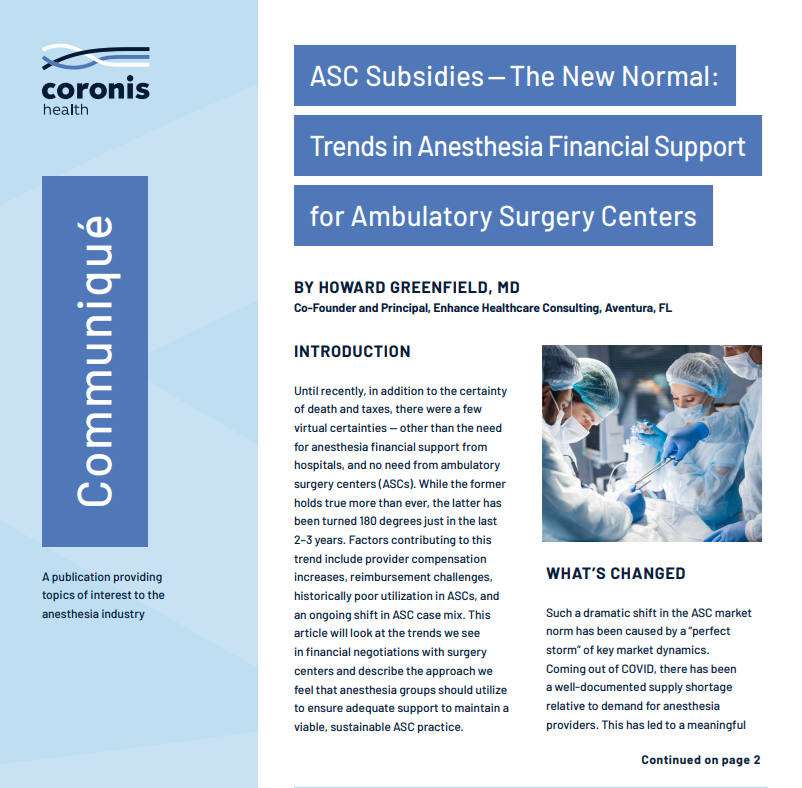
Fall 2026 Communiqué
Download the Fall 2026 Communiqué issue.

Why Revenue Gets Stuck: Finding the Operational Breakdowns That Delay Payment
Revenue cycle problems do not always come from one major failure. More often, payment is delayed by smaller operational breakdowns that happen across billing…

An Incidental Matter: Reviewing the Intricacies of Incident To Billing
It’s a rather strange term, isn’t it? Whoever introduced it into modern medical usage should be given a timeout for forcing this phrase onto…
Let's discuss your transformation
Wherever you want revenue cycle operations to go, we can help!
-
step 1
Connect
Tell us about your organization, specialty and revenue transformation goals.
-
step 2
Evaluate
We'll evaluate your current state and identify strategic opportunities for improvement.
-
step 3
Transform
Together we'll implement solutions that improve performance from day one.
